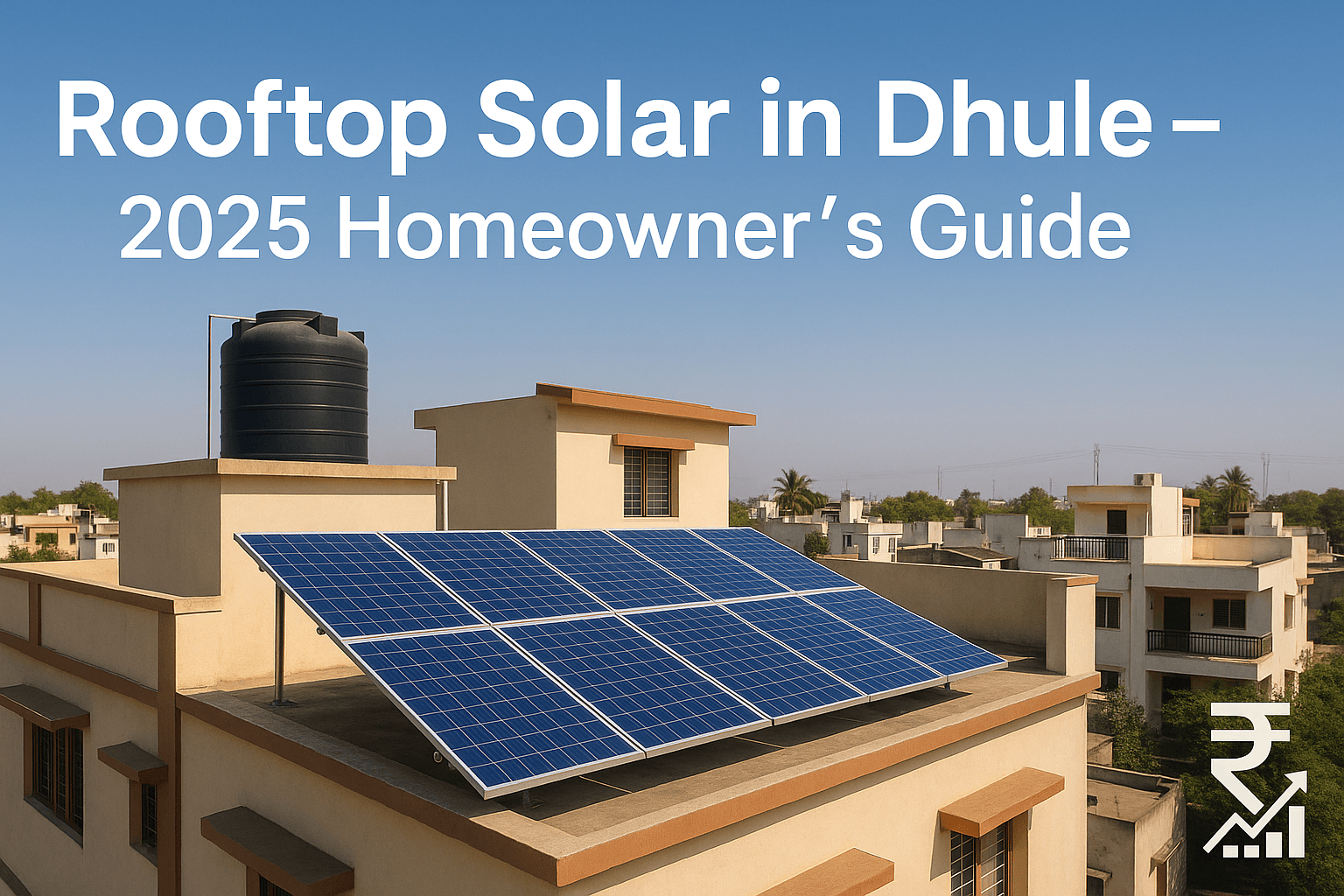
Rooftop Solar in Dhule: Complete Guide for Homeowners (2025 Edition)

Introduction
Electricity bills in Dhule, Jalgaon, and across North Maharashtra have been creeping up year after year. Residential consumers with higher monthly usage now pay well over ₹10 per unit in many slabs, even after recent “reductions.” For a typical middle-class family, it’s common to see monthly bills of ₹1,800–₹3,500 or more.
At the same time, Dhule district is one of Maharashtra’s best locations for solar power. Utility-scale solar parks were set up here precisely because the region gets strong sunshine and high solar irradiation, typically in the range of 5.5–6.0 kWh/m² per day. In simple language: your roof gets a lot of good-quality sun.
Put those two facts together and rooftop solar in Dhule is no longer a luxury. For many homes, it’s one of the most sensible financial decisions they can make in 2025.
This guide is written specifically for homeowners in Dhule, Jalgaon, and nearby towns in North Maharashtra. The goal is simple: explain rooftop solar in clear language, with realistic numbers, so you can decide confidently whether it’s right for you.
Why Solar Matters for Dhule
Dhule’s location and climate tick almost every box for rooftop solar:
- Plenty of sunshine: Maharashtra typically gets 250–300 sunny days per year with average solar radiation of 4–6 kWh/m²/day. Dhule is on the stronger side of that range.
- Hot summers, strong sun: Long, bright summers mean more units generated per kW of solar installed.
- High grid tariffs: Residential tariffs for 101–300 units per month in Maharashtra are now in the ₹12–13 per unit range for many consumers, with additional charges like FAC on top.
- Rising fuel adjustment and surcharges: Even if base tariffs are reduced slightly, periodic hikes in fuel adjustment charges keep pushing bills up.
- Government push for rooftop solar: The central PM Surya Ghar: Muft Bijli Yojana offers significant subsidies (up to ₹78,000) for residential rooftop solar systems up to 3 kW.
In Dhule, a properly designed 3kW solar system can easily offset a big chunk of your monthly consumption, especially if your family uses 250–350 units per month.
For Dhule, Jalgaon, Sakri, Shirpur, and other North Maharashtra towns, rooftop solar is not just “green.” It’s a practical way to:
- Reduce your grid dependence
- Stabilise your monthly electricity costs
- Get predictable savings for 20–25 years
How Rooftop Solar Works
Before talking about costs and subsidies, it helps to understand the basic pieces of a rooftop solar system. Don’t worry, you don’t need an engineering degree.
Main Components
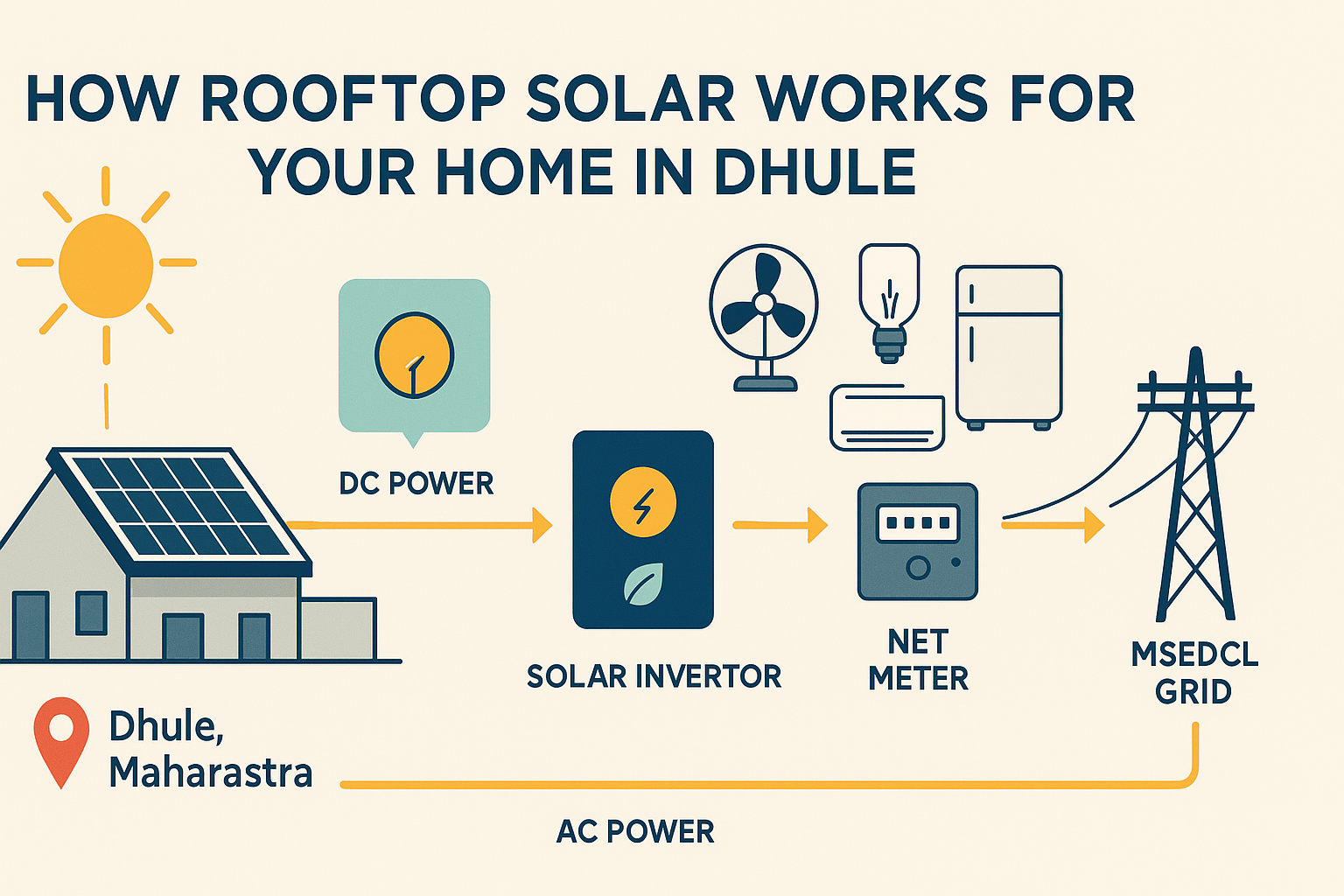
A typical on-grid rooftop solar system in Dhule consists of:
-
Solar panels (modules)
- Mounted on your rooftop facing south or south-west (usually).
- Convert sunlight directly into DC (direct current) power.
-
Solar inverter
- Converts DC power from panels into AC (alternating current), which your home appliances use.
- Synchronises with the MSEDCL grid so your system works safely alongside it.
-
Mounting structure
- GI or aluminium structures, properly anchored into the roof (RCC, sheet, or tiled).
- Designed to handle Dhule’s wind loads and monsoon conditions.
-
AC/DC cabling & protections
- DC cables from panels to inverter.
- AC cables from inverter to your main distribution board.
- Protection devices like DC isolators, AC MCBs/MCCBs, surge protection, earthing, and lightning protection.
-
Net meter (bi-directional meter)
- Installed by MSEDCL under the net metering policy.
- Measures units imported from the grid and units exported to the grid.
-
Existing grid connection
- Your MSEDCL line remains; solar works along with it.
- On-grid systems shut down during power cuts for safety (anti-islanding).
What Happens During the Day
Let’s take a typical sunny day in Dhule:
- Sunlight falls on your solar panels.
- Panels generate DC power.
- The inverter converts DC to AC and feeds it into your home’s wiring.
- Your loads (fans, lights, fridge, AC, motor, etc.) consume this solar power first.
- If solar generation is more than your current usage, the excess power automatically flows back to the grid through the net meter.
- If your usage is more than the solar generation at that moment (for example, at night or on a very cloudy day), you import the balance from the grid like before.
Net Metering in Simple Terms
At the end of the billing cycle, MSEDCL looks at:
- Units imported from the grid
- Units exported to the grid
Your bill is based on the net units (import – export), plus fixed charges and applicable surcharges.
So if your rooftop solar in Dhule generated a lot of surplus during the day, that surplus helps offset your evening and night consumption on the bill.
Get Your Custom ROI Report
See exactly how much you can save in Dhule with the latest government subsidies.
Costs, Subsidy, and Payback
This is what most Dhule homeowners really want to know: how much does it cost and when does it pay back?
Typical System Sizes for Dhule Homes
For middle-class homes in Dhule and Jalgaon, these sizes are the most common:
-
2 kW system
- Suitable for small homes with monthly usage around 120–180 units.
- Can handle basic loads: fans, lights, fridge, mixer, TV, some pump usage.
-
3 kW system
- Ideal for many 2–3 BHK homes with 200–300+ units/month.
- Can significantly cut the bill even with a 1–1.5 ton AC used moderately.
- This is the most popular “sweet spot” for rooftop solar in Dhule.
-
5 kW system
- For larger homes, multiple ACs, or where monthly usage is 350–500+ units.
- Often used in bigger bungalows or combined family houses.
-
10 kW system
- Suitable for large bungalows, small commercial setups, or mixed-use buildings.
- More common on institutional or small industrial roofs in North Maharashtra.
As a rough thumb rule, in Maharashtra’s climate, 1 kW of good-quality rooftop solar can generate about 1,400–1,600 units per year, averaging around 4–4.5 units per day over the year.
Ballpark Cost Range (On-Grid Systems)
For a good-quality on-grid rooftop system in Dhule with Tier-1 modules, a branded inverter, and proper structure and protections, approximate turnkey pricing (2025) is:
- 2 kW: ₹1.20–1.40 lakh
- 3 kW: ₹1.70–2.10 lakh
- 5 kW: ₹2.8–3.5 lakh
Final cost depends on:
- Brand of panels and inverter (Indian vs international, string vs microinverter)
- Roof type (RCC vs sheet vs complex layout)
- Cable lengths and earthing complexity
- Any civil work required (parapet wall, additional structural supports, etc.)
These ranges assume a professional solar installation Dhule by a local EPC like Ultron Power Systems, not the cheapest possible hardware from an online marketplace.
Sample 3 kW System Cost Breakdown (Dhule Home)
Let’s take a 3 kW rooftop solar system in Dhule as an example.
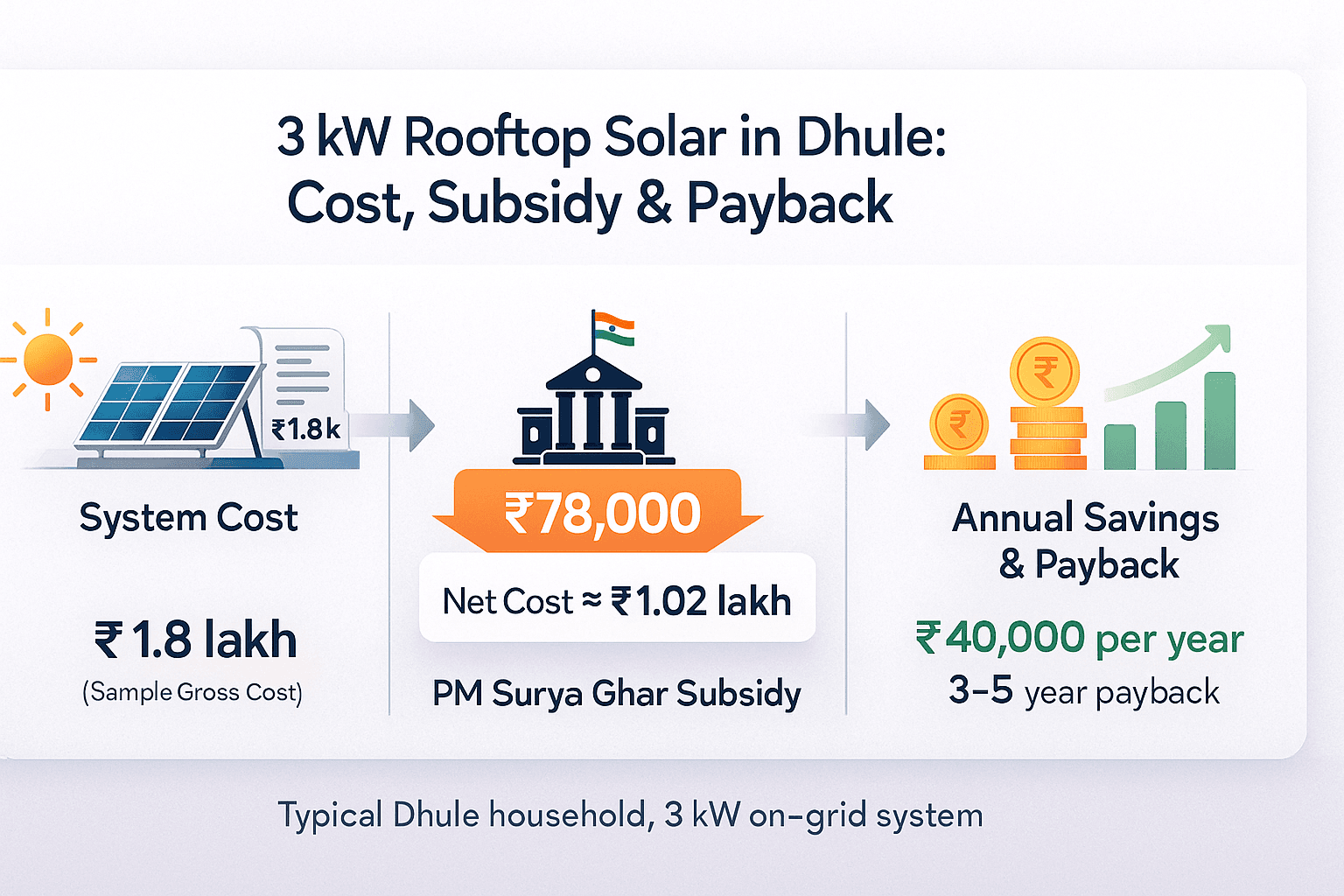
Gross system cost (pre-subsidy):
- 3 kW Tier-1 mono-PERC panels (about 7–8 panels): ~₹90,000
- 3 kW on-grid inverter (string type): ~₹35,000
- Mounting structures, fasteners, earthing: ~₹25,000
- AC/DC cabling, protections, junction boxes: ~₹20,000
- Design, engineering, installation labour: ~₹20,000
- Liaison work, documentation, testing & commissioning: ~₹10,000
Estimated total gross cost: around ₹1.80 lakh (₹60,000 per kW, including everything)
These are realistic working numbers for a well-executed rooftop solar project in Dhule in 2025, not ultra-budget shortcuts.
Central Government Subsidy (PM Surya Ghar)
Under PM Surya Ghar: Muft Bijli Yojana, central subsidy for residential rooftop solar is currently:
- Up to 2 kW: ₹30,000 per kW
- 2–3 kW: ₹30,000 per kW for first 2 kW + ₹18,000 per kW for the next 1 kW
- Above 3 kW: Maximum subsidy capped at ₹78,000
So, for a 3 kW system in Dhule:
- Subsidy = ₹30,000 × 2 + ₹18,000 × 1 = ₹78,000
- Net customer cost ≈ ₹1,80,000 – ₹78,000 = ₹1,02,000
This is a rough working illustration. Exact subsidy will depend on final MNRE norms, approved vendor, and portal process at the time of installation.
Example Savings and Payback for a Dhule Home
Assume:
- 3 kW system in Dhule
- Annual generation ≈ 4,500 units (1,500 units per kW per year)
- Effective blended grid tariff (including charges) ≈ ₹8.5–₹9 per unit for the slabs where solar primarily offsets your consumption
Then:
- Annual savings ≈ 4,500 × ₹9 = ₹40,500
- Net investment ≈ ₹1,02,000 (after subsidy, as per example above)
Simple payback ≈ 2.5–3 years
Even if we assume more conservative numbers—slightly lower generation in some years or lower realisable tariff benefit—the payback in Dhule usually falls between 3–5 years for a well-sized 2–3 kW system.
After that, most of the electricity generated for the remaining 20–25 year life of the panels is basically low-cost power, apart from occasional inverter replacement and minor maintenance.
Step-by-Step Process
Going solar should not feel mysterious. Here’s how a typical rooftop solar Dhule project runs when you work with a structured local EPC like Ultron Power Systems.
1. Initial Enquiry and Basic Discussion
- You share your latest 12 months of electricity bills (or at least 3–6 months).
- We understand:
- Your average monthly units
- Any planned changes (new AC, EV, borewell motor, etc.)
- Any space or shading concerns on the roof
2. Site Visit and Roof Assessment
A trained engineer visits your home in Dhule or Jalgaon:
- Measures available roof area
- Checks roof type (RCC, sheet, tiles)
- Identifies shading from nearby buildings, trees, water tanks, or chimneys
- Assesses cable routing and inverter placement (preferably a cool, accessible location)
3. System Design and Proposal
Based on the site visit:
- We suggest an optimal system size (e.g. 3 kW solar system Dhule for a 250–300 unit/month home).
- Share:
- Proposed layout (panels location and tilt)
- Expected annual generation
- Estimated savings
- Total cost, subsidy estimate, and net payable amount
- Tentative payback period
You get a clear written proposal—no vague promises.
4. Subsidy & Net Metering Paperwork
For eligible residential connections:
- Ultron Power Systems assists with:
- PM Surya Ghar portal registration and application
- Required documents (Aadhaar, bank details, electricity bill, etc.)
- Vendor selection process as per the portal
- MSEDCL net metering application and approvals
Most Dhule homeowners find these processes confusing; a local EPC handling end-to-end documentation is a big practical advantage.
5. Installation and Quality Checks
On installation days (usually 1–3 days for 2–3 kW systems):
- Mounting structures are placed and aligned.
- Panels are installed with proper clamping and torque.
- Cabling, earthing, and protections are fitted.
- Inverter is fixed and connected to your main distribution board.
- System is tested thoroughly (open circuit voltages, earthing resistance, insulation, etc.).
We also ensure there is clear access for future maintenance and cleaning.
6. Inspection, Net Meter, and Synchronisation
- MSEDCL or relevant authorities may conduct inspection as per local norms.
- Net meter is installed or replaced.
- System is officially charged and connected under net metering.
From this point, your Maharashtra rooftop solar plant is live and generating.
7. Handover and Training
We:
- Explain basic system indicators on the inverter and/or app.
- Show you how to interpret daily and monthly generation.
- Give a simple maintenance guide (how often to clean panels, what to watch out for).
- Hand over documentation and warranties.
Why Choose Ultron Power Systems
There are many vendors on the internet. But rooftop solar is not just “buy and forget” hardware. It’s a 20+ year asset on your roof.
Here’s why a local EPC partner in Dhule like Ultron Power Systems matters.
1. Local Presence in Dhule and North Maharashtra
- Based in Dhule, operating across Jalgaon and surrounding North Maharashtra towns.
- Easy to reach for site visits, inspections, and service calls.
- We understand:
- Local climate and dust conditions
- Typical roof types in the region
- Practical shading patterns in dense urban lanes vs open outskirts
2. Design Depth, Not Just kW Selling
We don’t just ask, “How many kW do you want?” Instead, we:
- Analyse your past consumption pattern.
- Allow for future loads like AC, EV, or borewell.
- Match inverter and panel selection to your realistic needs and budget.
- Optimise tilt and orientation for Dhule’s sun path, not generic metro-city assumptions.
3. End-to-End Paperwork Support
- PM Surya Ghar portal registration and documents
- Vendor selection workflow as per MNRE guidelines
- MSEDCL net metering applications and follow-ups
- Commissioning reports and compliance
You don’t have to keep running to offices for signatures and stamps.
4. Quality-Focused Hardware Choices
- MNRE-approved and Tier-1 panel brands
- Reliable inverters with good service networks in Maharashtra
- Proper earthing, surge protection, and cable management
- Structures designed for local wind loads and monsoon conditions
We design for long-term safety and performance, not just for the lowest upfront quote.
5. After-Sales and Monitoring
- Periodic health checks, if you opt for AMC
- Support for warranty claims if required
- Guidance on monitoring apps and reading your generation data
Rooftop solar in Dhule should feel like a low-maintenance asset, not a constant headache.
Frequently Asked Questions
1. Will rooftop solar damage my roof?
When installed correctly, no.
- RCC roofs: We use ballasted or anchor-based structures with proper waterproofing where necessary.
- Sheet roofs: Use specialised clamps or purlin-based mounting that avoids random drilling and leakage.
A professional EPC ensures the structure is engineered and roof integrity is maintained.
2. What happens during power cuts?
On-grid systems are designed to switch off during power cuts to protect utility workers (anti-islanding protection).
- During an MSEDCL outage, your on-grid system will shut down.
- If you want backup during power cuts, you need:
- A hybrid inverter with batteries, or
- A separate backup (UPS, inverter, generator)
For most Dhule homes, an on-grid system without batteries is still the best value for money purely from savings and payback.
3. How much maintenance is required?
Maintenance is minimal:
- Clean panels with soft water and a wiper/cloth every 15–30 days depending on dust.
- Check for:
- Loose wires or animal damage
- Visible cracks or hotspots (rare with good-quality panels)
- Inverter usually needs no regular “service” beyond ensuring it’s in a ventilated, dry area.
We give you a simple maintenance checklist at handover.
4. Will solar work on cloudy or rainy days?
Yes, but with reduced output.
- On very cloudy monsoon days, generation can drop significantly.
- Over the year, Dhule still gets strong sunshine, especially from October to May, which compensates for weaker monsoon months.
Solar systems are designed on annual average generation, not on a single bad-weather day.
5. What if I shift house after installing solar?
Options:
- If the new owner is interested, the solar plant can be part of the property sale value.
- You can also explore relocating the system to your new home, subject to structural feasibility and approvals (costs apply).
A well-documented rooftop solar system is often a positive point for property buyers, especially in cities like Dhule and Jalgaon where electricity bills are a regular pain point.
6. Is 3 kW enough for my home?
Rough guideline for Dhule homes:
- Up to 120 units/month: 1–2 kW
- 150–250 units/month: 2–3 kW
- 250–350 units/month: 3–4 kW
- 350+ units/month or multiple ACs: 5 kW or more
The best way is to let a local EPC like Ultron Power Systems study your Bills + future plans and design the system accordingly.
7. How long do panels and inverters last?
- Panels: 25 years or more, with a performance warranty (for example, 80–85% output at 25 years).
- Inverter: Typically 8–12 years, depending on brand, usage, and environment. One replacement over the system life is normal.
We design with realistic performance assumptions rather than perfect lab conditions.
Conclusion
For homeowners in Dhule, Jalgaon, and North Maharashtra, rooftop solar has moved from “nice to have” to “financially obvious” in many cases.
You get:
- Strong, reliable sunshine
- High and rising grid tariffs
- Central subsidy under PM Surya Ghar
- Paybacks often in the 3–5 year range
- 20+ years of predictable low-cost electricity after that
The key is to work with a local, technically sound EPC that understands design, documentation, and long-term support—not just how to low-ball a tender.
If you’re serious about reducing your electricity bills and stabilising your home’s energy costs, this is a good time to evaluate a 2–3 kW rooftop solar system in Dhule properly.
Ultron Power Systems is here to help you with:
- Honest assessment of your bills and needs
- Transparent design and costing
- End-to-end handling of subsidy and net metering
- Clean, professional installation and long-term support
Your roof is already taking the sun every day. It might as well start paying your bills.
Need a solar partner?
Let’s turn this insight into your next project.
Our engineers can design a custom solar system for your site, handle paperwork, and monitor performance once it is live.
Ultron Solar Team
Editorial Desk
"Our editorial team consists of seasoned solar engineers and policy consultants dedicated to bringing transparent, data-driven energy insights to the people of North Maharashtra."
Share this post