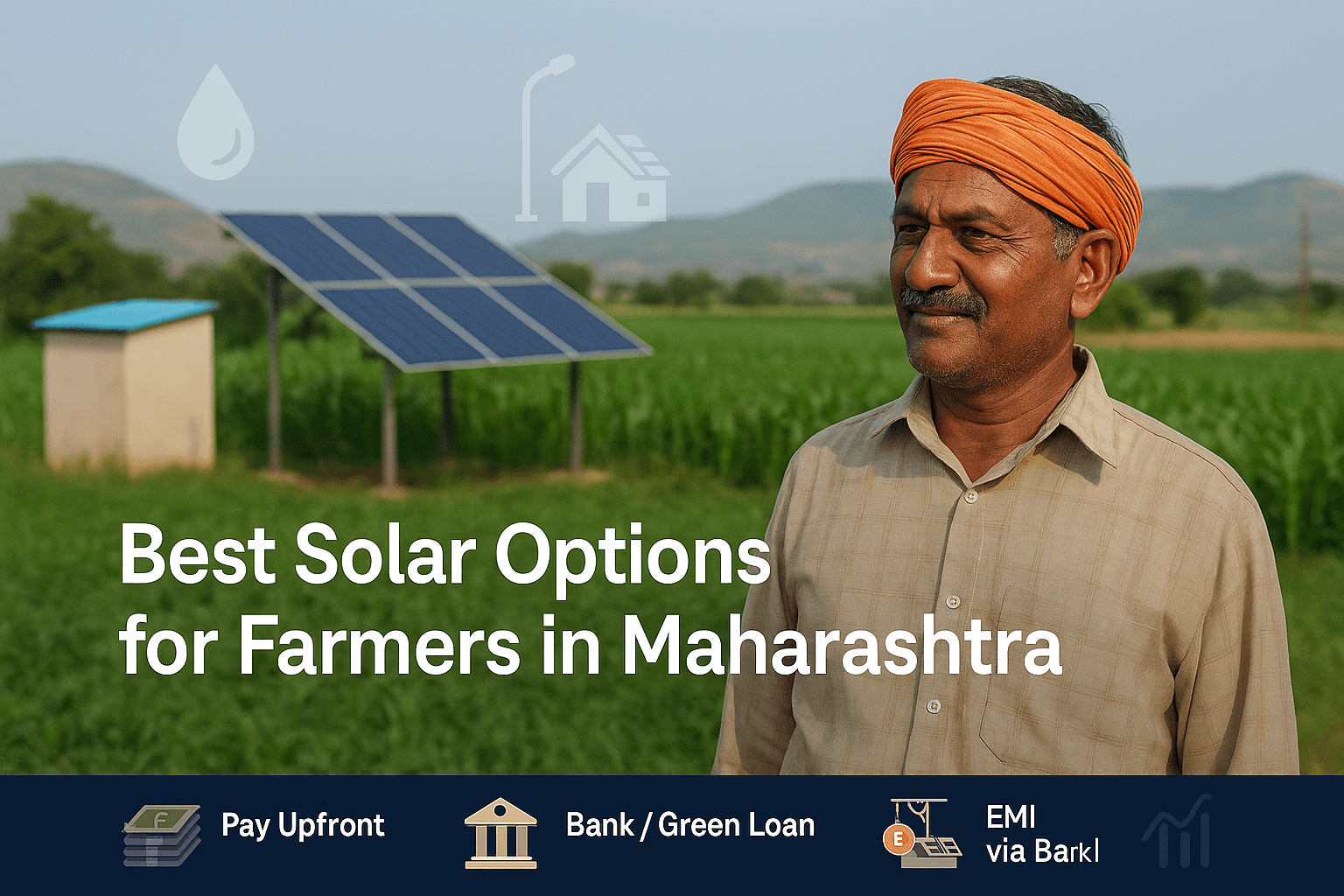
Best Solar Options for Farmers in Maharashtra, India

Introduction
For most farmers in Maharashtra, electricity and diesel are not just “bills” – they decide whether you get timely water, whether your harvest is safe, and whether you can sleep peacefully at night. When the grid goes off in the evening or diesel prices jump again, the stress lands directly on the farmer.
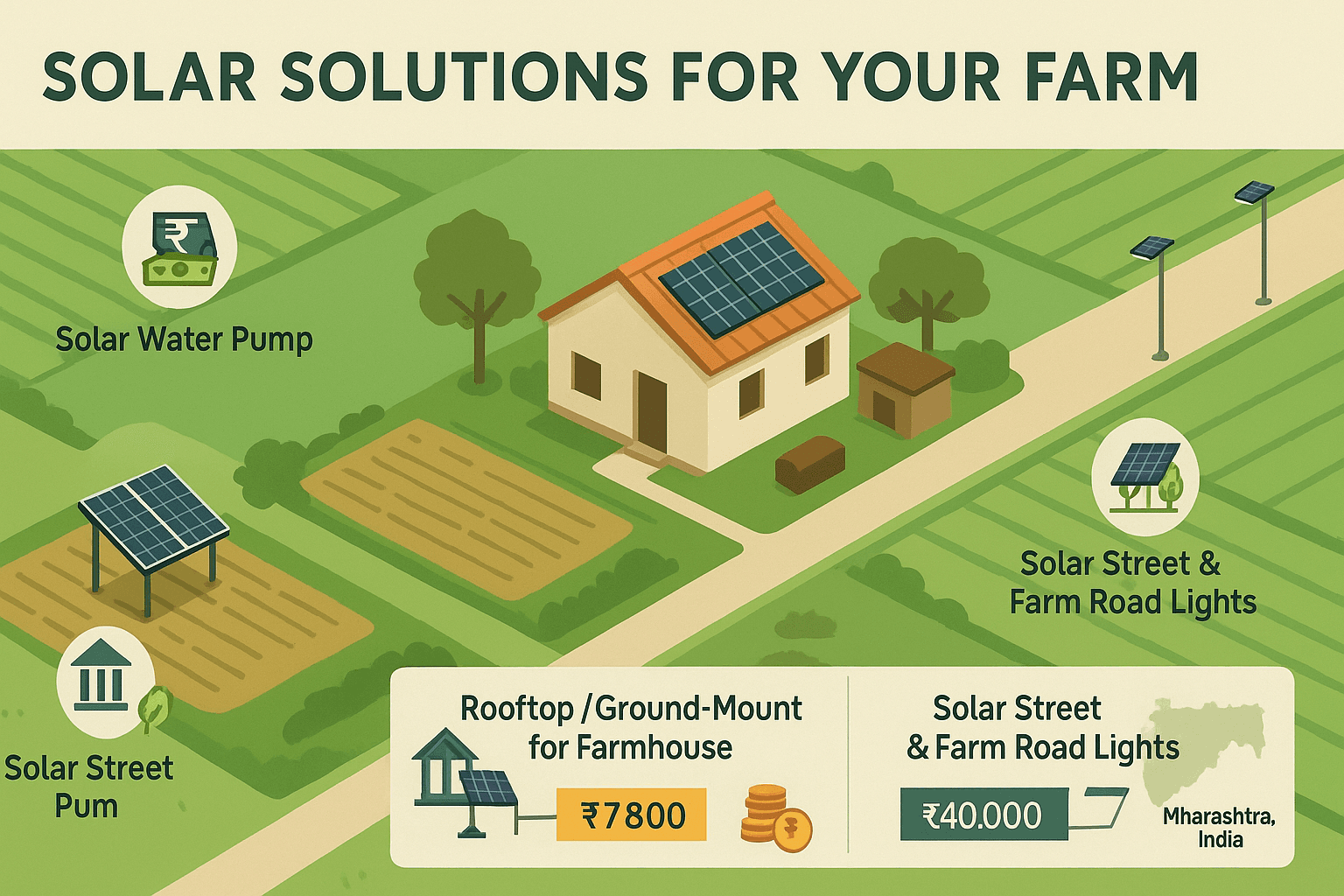
Solar cannot fix everything. It can give you more control over three critical things:
- Water for irrigation
- Light and security for your farm and approach roads
- Reliable power for your farmhouse and small agro operations
In this guide, we look at practical solar options for farmers across Maharashtra – from North Maharashtra and Khandesh to Marathwada, Vidarbha and Western Maharashtra – and how to choose what to start with.
Why Solar Makes Sense for Farmers in Maharashtra
Real Problems Farmers Face
Across districts – Dhule, Jalgaon, Aurangabad, Latur, Nagpur, Kolhapur, Satara – the situation is similar:
- Erratic grid power
- Single-phase supply that comes at odd hours (midnight, early morning).
- Long load shedding in peak summer.
- Low voltage that can damage motors.
- High diesel cost
- Borewell irrigation on diesel pumps in remote fields.
- Frequent refilling trips from village to pump.
- Maintenance of old diesel engines – oil changes, breakdowns, mechanics.
- Seasonal water stress
- Rabi and summer crops needing timely irrigation.
- Deep borewells in parts of Marathwada and Vidarbha.
- Drip and sprinkler systems that work best with consistent pressure.
- Safety and security
- Long, dark farm roads from village to field.
- Risk of theft of crops, pumps, and tools in unlit areas.
- Accidents on kachha roads with no light.
All of this eats into time, money, and peace of mind.
How Solar Fits Into This
Solar solutions can’t replace good rainfall or strong government support. But they reduce dependence on:
- Unpredictable grid power
- Expensive diesel
- “Jugaad” street lights that fail every monsoon
Solar is attractive for farmers because:
- Sunlight in Maharashtra is abundant for most of the year.
- Running cost of solar systems is very low once installed.
- Many solutions (pumps, lights, small systems) can work independently of the grid.
Solar Water Pumps: Reliable Water Without Diesel
If diesel and erratic single-phase supply are your biggest headache, solar water pumping is usually the first thing to evaluate.
Types of Solar Water Pumps
You’ll commonly hear these terms:
- Surface pumps
- Pump is installed at or near the surface (canal, tank, open well).
- Suitable where water level is not too deep.
- Submersible pumps
- Pump is installed deep inside a borewell.
- Used when static water level is deeper – common in parts of Marathwada, Vidarbha and North Maharashtra.
By power and motor type:
- DC solar pumps
- Run directly on DC power from solar panels via a controller.
- Often more efficient but can be costlier and more specialized.
- AC solar pumps
- Use a standard AC motor with a solar pump controller (VFD/inverter).
- Easier to service because local motor mechanics understand AC motors.
- Can be integrated with grid or generator in some hybrid setups.
The solar pump controller is the brain. It:
- Converts DC from panels to AC (for AC pumps).
- Manages soft starting and stopping.
- Protects against dry run, over-voltage, and under-voltage (in better-quality systems).
Basics of HP Sizing
Farmers talk in HP (horsepower), not kW. Simple conversion:
- 1 HP ≈ 0.75 kW
So a 5 HP pump is roughly 3.75 kW.
To size a solar pump, key factors are:
- Bore depth and water level
- Static water level (when pump is off).
- Dynamic water level (when pump is running).
- Required discharge
- How many litres per hour you need.
- Depends on crop type, area under cultivation, and irrigation method.
- Hours of operation
- How many hours per day you want the pump to run on solar.
- Whether you run it only in daylight or also with grid at night in a hybrid setup.
A 3 HP solar pump might suit a small holding with shallow to medium-depth bore and drip irrigation, while a 7.5 HP or 10 HP system may be needed for deeper bores and larger areas under flood irrigation. Correct sizing needs a proper survey, not guesswork.
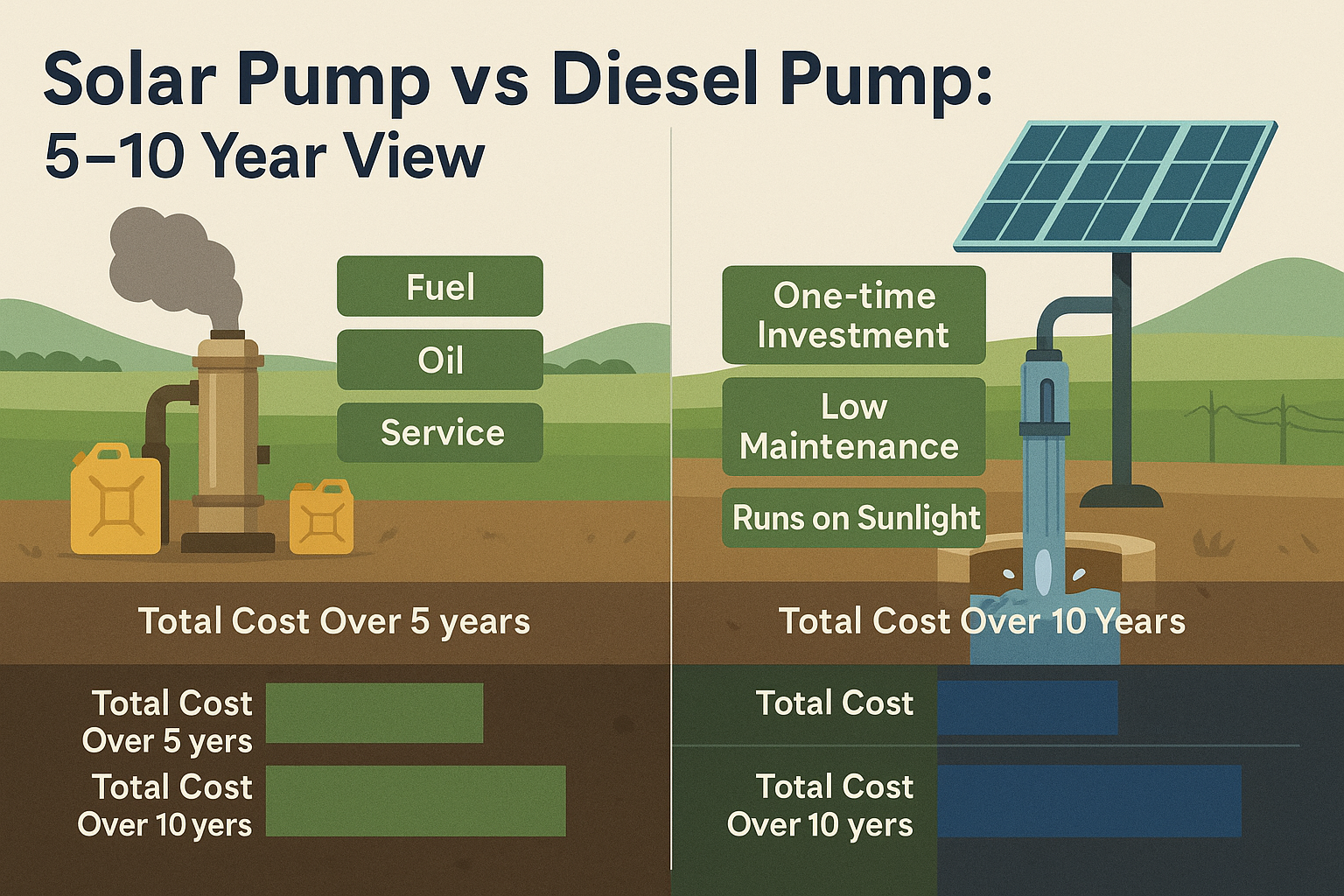
Diesel vs Solar Pump Over 5–10 Years
Farmers feel the diesel cost every week. The math is brutal over time.
Diesel pump:
- Upfront cost: lower than a solar pump.
- Recurring costs:
- Diesel fuel every season.
- Engine oil, filters, periodic servicing.
- Transport to bring diesel to the field.
- Occasional breakdown repairs.
- If fuel prices rise, your irrigation cost rises immediately.
Solar pump:
- Upfront cost: higher (pump + panels + structure + controller).
- Recurring costs:
- Basic maintenance of panels (cleaning).
- Occasional controller or motor servicing over many years.
- Sunlight is free; your per-hour pumping cost drops dramatically.
Over 5–10 years, especially for farmers using diesel heavily, solar often works out cheaper:
- Diesel costs + maintenance keep adding every season.
- Solar capex is largely one-time, with modest maintenance.
Free Solar Pump Feasibility Report
Assess your borewell capacity and see how much diesel you can save with a solar irrigation system.
Where Solar Pumps Make the Most Sense
Solar pumps are usually the strongest option when:
- No reliable grid at the farm, or only single-phase supply at odd hours.
- You rely heavily on diesel irrigation.
- Your borewell is reasonably productive and you want to:
- Run drip or sprinkler systems.
- Ensure water at fixed times rather than waiting for night-time power.
They are also useful when you want to reduce labour – no daily diesel runs, no night-time irrigation.
Solar Street and Farm Road Lights
After water, light and safety come next.
Where Farmers Use Solar Lights
Common use-cases in Maharashtra’s rural areas:
- Approach roads from village to farm
- Long kachha or tar roads used by tractor, two-wheelers, bullock carts.
- Dark stretches increase risk of accidents and theft.
- Around borewell and pump house
- Night-time visits become safer.
- Deterrent against tampering and theft.
- Cattle sheds and animal areas
- Helps monitor animals and prevent theft or predator attacks.
- Storage areas and small processing sheds
- Lighting around grain storage rooms, onion/potato sheds, dairy sheds, etc.
- Village lanes and chowks
- Shared community lights that improve overall security and comfort.
Solar street and area lights work well here because pulling grid lines and paying new connection charges for every pole is often uneconomical.
Integrated vs Split Solar Lights
Two broad designs:
- Integrated (all-in-one) lights
- Panel, battery, LED and controller in one unit.
- Mounted at top of the pole.
- Easy to install, clean look.
- Good for small to medium applications.
- Split lights
- Panel mounted separately; battery and LED fixture may be on or near the pole.
- More flexibility in positioning panel for better sunlight.
- Easier to maintain/replace some components separately in certain designs.
Key Technical Points (Explained Simply)
When choosing solar lights, focus on:
- Battery type
- Modern systems often use LiFePO4 or other lithium batteries:
- Lighter, better cycle life.
- Less maintenance than old lead-acid.
- Modern systems often use LiFePO4 or other lithium batteries:
- Backup hours
- How many hours the light should run at full/partial brightness:
- 8–12 hours is typical for farm roads.
- How many hours the light should run at full/partial brightness:
- IP rating
- Indicates protection against dust and water.
- Rural and farm environments are dusty, and monsoon can be harsh.
- Go for robust, weather-resistant fittings; cheap lights die quickly in first or second monsoon.
For farmers, the goal is simple: put light where it really changes your life – that first stretch from village to farm, around sheds and pump houses.
Small Rooftop and Ground-Mount Systems for Farmhouses and Sheds
Once water and basic lighting are under control, the next step is usually power for the farmhouse and agro operations.
Farmhouse Loads
On many farms in North Maharashtra, Marathwada, Vidarbha and Western Maharashtra, the farmhouse or “ota” area has:
- Fans and lights
- TV, mobile charging, possibly a computer
- Fridge and mixer
- Small water pump for overhead tank
- Sometimes a small AC or desert cooler
These are perfect for small rooftop or ground-mount solar systems, typically in the 2–5 kW range.
Sheds and Agro-Processing Loads
Separate from the house, you may have:
- Small dairy set-up and milk chilling units.
- Cold room for fruits, vegetables, or flowers.
- Grading and sorting machines, small flour mills, or pulverisers.
- Packing area lighting and plug points.
These loads need more careful design. Options include:
- On-grid systems where grid power is reasonably reliable.
- Hybrid systems with batteries where outage is frequent and you can’t afford downtime (for example, milk chilling).
On-Grid vs Hybrid vs Off-Grid
- On-grid
- Solar works with the grid; no batteries.
- Best when outages are occasional or short.
- Lowest cost per kW; best when your goal is bill reduction.
- Hybrid (solar + grid + battery)
- Uses both panels and grid, plus a battery bank.
- Can run critical loads during power cuts.
- Ideal where you need continuous power for specific equipment.
- Off-grid (solar + battery only)
- No grid dependence at all.
- Completely independent, but batteries add cost.
- Used in very remote locations with no grid or extremely poor grid.
For most farmers, a mix of on-grid and small critical backup is more economical than trying to run everything on batteries.
Government Schemes and Subsidies for Agricultural Solar
Both the central government and the Government of Maharashtra run schemes from time to time that support:
- Solar water pumps for agriculture.
- Decentralised solar plants linked to agriculture feeders.
- Small solar systems for farmers, FPOs, or rural enterprises.
Learn more about the PM-KUSUM Scheme and how it can benefit your farm.
The exact scheme names, subsidy percentages and eligibility conditions change over time:
- Subsidies can depend on:
- Pump capacity (HP/kW).
- Category of farmer (small, marginal, general).
- Location and type of scheme.
- Some schemes cover a large part of the pump or system cost, with the farmer paying the remaining share.
- Others support group projects through cooperatives, FPOs, or Gram Panchayats.
The important point is not to memorise scheme codes. It is to:
- Check current schemes before finalising a project.
- Work with a partner who actually tracks these updates and can guide on:
- Application process.
- Required documents.
- Realistic timelines.
A good EPC will tell you clearly what is confirmed today and what is still only a “proposal on paper”.
How to Decide Which Solar Option to Start With
Don’t try to do everything at once. Start where the pain and money loss are highest.
1. Diesel Irrigation Cost Very High → Start with Solar Pump
Signs this is your priority:
- You spend a lot on diesel every season for borewell irrigation.
- Grid supply to the farm is unreliable or at awkward hours.
- Your crops suffer when diesel is not available or the engine fails.
Here, a correctly sized solar pump can:
- Cut your diesel use drastically.
- Reduce dependence on night-time supply.
- Give you more predictable irrigation hours.
2. Safety and Access are Major Issues → Start with Solar Street/Farm Lights
Prioritise solar street/farm lights if:
- You or your family regularly travel on dark farm roads late at night or early morning.
- There have been thefts or attempted thefts.
- You are forced to visit the borewell/pump area at odd hours.
A few well-placed solar street lights on the approach road and around sheds can:
- Reduce accident risk.
- Deter casual theft.
- Make everyone more willing to visit the farm at necessary times.
3. High Bills at Farmhouse/Storage → Start with Rooftop/Ground-Mount
If grid is fairly available but:
- Your farmhouse, dairy shed, or cold store attracts high monthly bills.
- You want to reduce dependence on feeder load shedding schedules.
Then it may make sense to:
- Add a small rooftop or ground-mount system first.
- Later, consider hybrid backup for critical loads if outages are severe.
Step-by-Step Plan Instead of One Big Jump
A typical staged plan for many farmers in Maharashtra might look like:
- Phase 1: Put up 2–4 high-quality solar street lights on the main approach and near pump house.
- Phase 2: Install a solar pump (or upgrade to one) for the main borewell.
- Phase 3: Add a small 2–5 kW system at the farmhouse or main shed for power savings and backup.
Each phase solves a real problem and can be timed based on cash flow, scheme availability, and harvest cycles.
How Ultron Power Systems Helps Farmers Across Maharashtra
Ultron Power Systems works with farmers in Dhule, Jalgaon and the wider North Maharashtra region, and we understand the realities on the ground. Our approach for agricultural and rural projects is simple: visit, listen, explain clearly, then design.
1. Site Visits and Basic Surveys
We don’t design from a city office only. We:
- Visit your farm, borewell, sheds and farmhouse.
- Measure distances, check shadows, assess land and roof suitability.
- Understand:
- Crop pattern and water needs.
- Present pumping method (grid/diesel).
- Current problems with access and safety.
This is where decisions about pump capacity, light placement and system size actually become meaningful.
2. Simple Explanations in Marathi and Hindi
Technical English doesn’t help when your problem is standing water in the field or a dry bore.
We:
- Explain options in clear Marathi and Hindi, using examples:
- How many hours the pump is likely to run in a typical day.
- Rough idea of diesel savings.
- What happens in cloudy weather.
- Clarify jargon:
- HP vs kW (1 HP ≈ 0.75 kW).
- On-grid vs off-grid vs hybrid.
- What “controller” or “inverter” actually does.
You should understand what you are buying and why – not just sign because someone said “government scheme”.
3. System Sizing for Pumps and Lights
For solar pumps, we:
- Look at bore depth and water level.
- Discuss area under irrigation and type of crops.
- Consider whether you use drip, sprinkler, or flood irrigation.
- Propose pump HP and solar array size that balances performance and budget.
For solar street and farm lights, we:
- Walk the route with you.
- Identify where light really changes safety.
- Suggest pole locations, heights, and light wattages.
- Choose models that can survive dust, heat and monsoon, not just look good on paper.
4. Assistance with Paperwork for Applicable Schemes
Where appropriate schemes exist and you qualify, we:
- Help collect the required documents.
- Provide technical details and quotations in the format needed.
- Guide you through the basic application steps.
We also tell you honestly when something is not yet notified or practically available, so you can plan with realistic expectations.
5. After-Sales Support in Rural Locations
Solar pumps and lights sit out in the sun, dust and rain all year. They will need:
- Occasional cleaning and basic checks.
- Rare but important servicing of controllers, motors or batteries.
We plan installations so that:
- Access for maintenance is reasonable.
- Spare parts and service support are thought about before installation, not after a failure.
For farmers, the real value of a partner is not just the installation day photos. It’s the ability to call someone two years later when you suspect the pump is not giving the same discharge, or when one of the lights stops working after a storm.
Conclusion
For farmers across Maharashtra – from the sugarcane belts of Western Maharashtra to the cotton and soybean fields of Vidarbha, the vineyards of Nashik region and the banana belts of North Maharashtra – solar is no longer a luxury. It is a practical tool that can:
- Cut diesel and electricity expenses.
- Reduce dependence on erratic grid supply.
- Make farms and farm roads safer and more usable.
The trick is not to chase every new gadget. It is to ask:
- Where is my biggest pain today – water, light, or power bills?
- What can I realistically invest this year?
- Which solar solution gives me the highest benefit for that investment?
Whether it’s a solar water pump, solar street lights or a small rooftop/ground-mount system, a well-designed project can quietly work for you season after season.
Ultron Power Systems is committed to being a long-term partner to farmers – not just a one-time supplier. With proper sizing, honest advice, and dependable after-sales support, solar can become an asset that works on your farm even when you are asleep.
Need a solar partner?
Let’s turn this insight into your next project.
Our engineers can design a custom solar system for your site, handle paperwork, and monitor performance once it is live.
Ultron Solar Team
Editorial Desk
"Our editorial team consists of seasoned solar engineers and policy consultants dedicated to bringing transparent, data-driven energy insights to the people of North Maharashtra."
Share this post