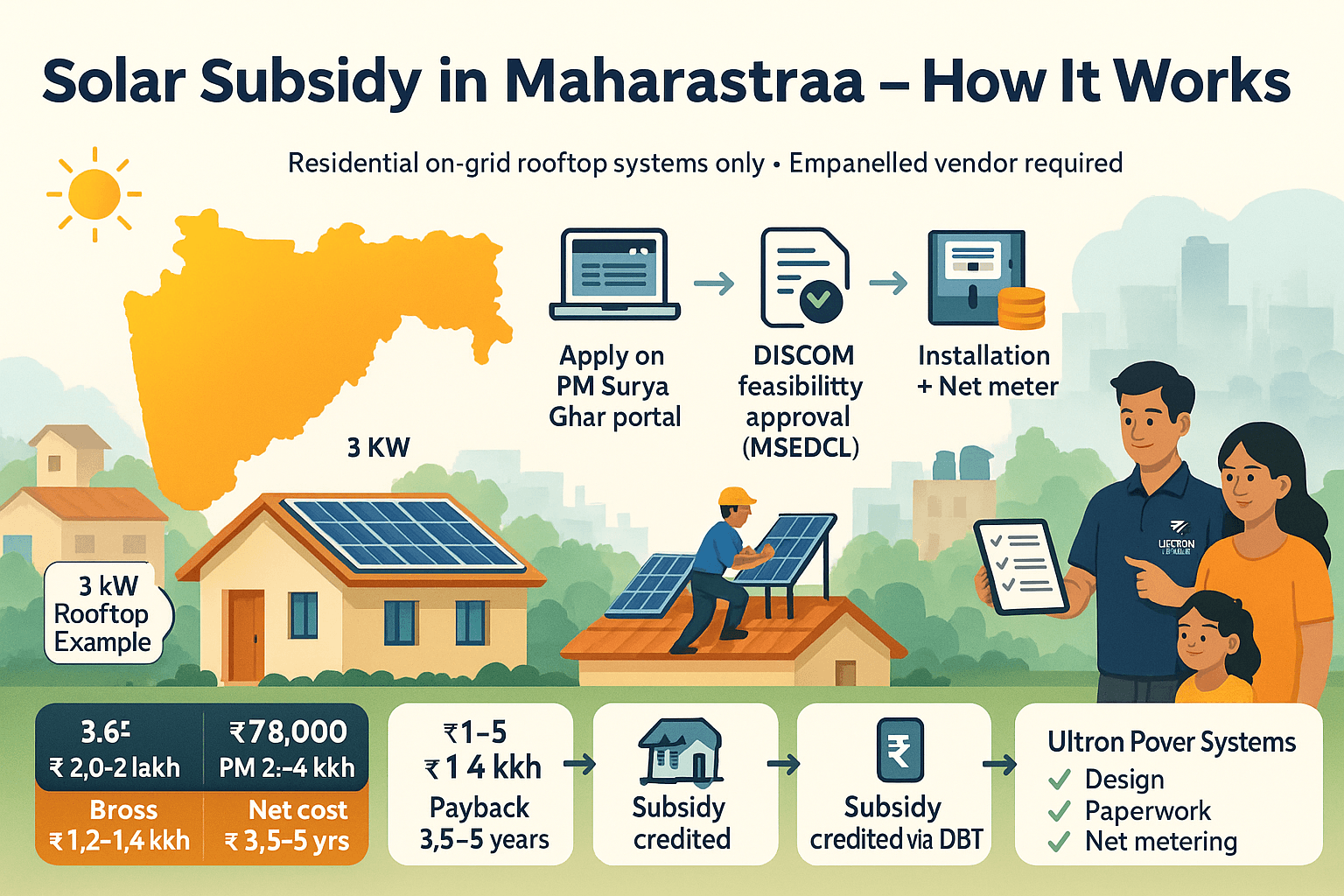
Government Subsidy for Solar in Maharashtra: A Practical Guide for Homeowners

If you live in Dhule, Jalgaon, or anywhere in North Maharashtra, you’ve probably heard this line:
“Government se subsidy milti hai solar pe, but process bahut jhanjhat wala hai.”
The first half is true.
The second half doesn’t have to be—if you know the steps and have the right EPC partner.
This guide explains:
- How the central government subsidy (PM Surya Ghar: Muft Bijli Yojana) works in Maharashtra
- How much money you can realistically expect
- Who is eligible and what the process looks like
- How Ultron Power Systems helps you from portal registration to subsidy credit
1. What Subsidy Can You Get in Maharashtra?
For most residential rooftop systems in Maharashtra, the main scheme is:
PM Surya Ghar: Muft Bijli Yojana (Central Government)
Under this scheme, residential consumers installing on-grid rooftop systems can get:
- ₹30,000 per kW for the first 2 kW
- ₹18,000 per kW for the next 1 kW (up to 3 kW)
- Subsidy capped at ₹78,000 for systems 3 kW and above
So:
- 1 kW system → ₹30,000 subsidy
- 2 kW system → ₹60,000 subsidy
- 3 kW system → ₹78,000 subsidy
- 4 kW, 5 kW, 10 kW… → still ₹78,000 max subsidy (central)
On top of this, there are special schemes and extra support for:
- Below Poverty Line (BPL) and Economically Weaker Sections (EWS)
- Some specific categories like SC/ST in certain state programmes
These can push the effective subsidy even higher for eligible households, sometimes covering 90–95% of system cost for small 1 kW setups designed for low-usage homes.
For a typical middle-class home in Dhule or Jalgaon installing 2–3 kW, the central subsidy alone usually covers a big chunk of the cost.
2. Who Is Eligible for Subsidy?
In simple terms, you’re usually eligible if:
- You are a residential consumer (individual house, flat, housing society)
- You have a valid electricity connection in your name with MSEDCL or relevant DISCOM
- You have suitable rooftop space (shadow-free, structurally sound)
- You are installing an on-grid rooftop system (not just a random off-grid inverter)
- You apply through the official PM Surya Ghar portal and follow the process
Common restrictions:
- Subsidy is primarily for residential category, not standard commercial/industrial meters
- You generally can’t claim subsidy twice for the same connection/rooftop
- The system must be installed by a registered/empanelled vendor as per portal norms
If you’re not sure whether your home qualifies, a quick feasibility check by Ultron’s team clears that up before you spend anything.
3. How the Subsidy Process Works (Step by Step)
Here’s the typical flow for a homeowner in Maharashtra:
Step 1: Portal Registration
- Visit the PM Surya Ghar (National Rooftop Solar) portal.
- Select:
- State: Maharashtra
- Your DISCOM (e.g., MSEDCL)
- Enter your consumer number from your electricity bill.
- Verify via OTP and create your login.
Step 2: Rooftop Solar Application
You submit an application with:
- Proposed system size (e.g., 3 kW)
- Basic roof details
- Installer/vendor (must be empanelled as per the scheme)
At this stage, Ultron Power Systems helps you:
- Decide the right capacity based on your load pattern and roof
- Ensure application details (name, address, load, category) match your bill
- Avoid common rejection reasons (wrong category, mismatched details, etc.)
Step 3: Feasibility & Approval from DISCOM
Your DISCOM (e.g., MSEDCL) checks:
- Whether your connection is suitable
- Technical feasibility (transformer loading, phase, etc.)
They issue a feasibility approval.
Only after this you should move to full installation.
Step 4: System Design, Supply & Installation
Your EPC partner (Ultron) handles:
- Site visit and final design (panel layout, inverter sizing, string design)
- Supply of MNRE-compliant modules and inverters
- Structure, wiring, earthing, DC/AC protection, and safety hardware
- On-site installation by trained technicians
All of this must match the standards required by the scheme.
Step 5: Net Metering & Inspection
After installation:
- Your DISCOM does inspection / commissioning check
- Net meter is installed or existing meter is replaced
- The system is officially commissioned and connected to the grid
We coordinate with the local MSEDCL office, arrange required documents and forms, and ensure photos, wiring diagrams, and test reports are as per format.
Step 6: Uploading Documents on Portal
Post-commissioning, you or your vendor must upload:
- Commissioning photos (modules, inverter, net meter, nameplate details)
- Installation report
- Net meter details
- Invoices with GST details and payment proof
If everything is in order, your application moves to subsidy approval.
Step 7: Subsidy Credited via DBT
Finally:
- Subsidy is directly transferred to your bank account (Direct Benefit Transfer)
- You get SMS/email confirmation from the portal/DISCOM
From your side, total paperwork looks like a headache.
From our side, it’s just another Tuesday.
4. How Much Money Do People Actually Save?
Let’s take a typical example for Dhule / North Maharashtra:
Example: 3 kW Residential System (On-Grid)
- Indicative system + installation cost: ~₹2.0–₹2.2 lakh
- Central subsidy (up to 3 kW): ₹78,000
- Net cost after subsidy: roughly ₹1.2–₹1.4 lakh (approx.)
Generation:
- 3 kW system → roughly 360–450 units/month (depending on season & rooftop)
- At a blended tariff of ₹8–₹10/unit, that’s ₹2,800–₹4,000/month of savings
Rough simple payback:
- Around 3.5–5 years in many cases
After that, you’re effectively running on deeply discounted power for the remaining 20+ years of the system life.
5. Common Mistakes That Can Kill Your Subsidy
Lots of people lose subsidy or face delays because of simple errors:
- Installing the system before portal feasibility approval
- Using a non-empanelled or non-compliant vendor
- Mismatch between bill details and application details (name, address, category)
- Missing or poor-quality photos and technical documents
- No proper net-metering application or incomplete forms
By the time they realise, it’s too late—the system is installed, money spent, and the subsidy is either delayed for months or rejected.
That’s exactly what we try to prevent.
6. Why Choose Ultron Power Systems for Subsidy-Backed Solar?
You’re not just buying panels. You’re buying:
- Design
- Execution
- Paperwork
- Support for 20+ years
Here’s what we do differently for Dhule, Jalgaon, and North Maharashtra homes:
a) End-to-End Subsidy & Net Metering Support
- Help you register on the PM Surya Ghar portal
- Fill online applications correctly (no guesswork)
- Coordinate for feasibility approvals with MSEDCL
- Prepare and upload photos, commissioning reports, and invoices as per requirement
- Track your application status and guide you till DBT credit hits your account
You focus on choosing the right system and paying less on your bills.
We handle the boring part.
b) Compliance-First Engineering
Our systems are designed so that:
- All modules and inverters meet MNRE and DISCOM norms
- Earthing, protections, cable sizing, and structure follow good engineering practice
- Documents (SLD, test results, panel layout) are ready when inspectors ask
That means fewer objections, smoother inspections, and faster commissioning.
c) Local Presence, Real Projects
We’re not a random website selling pan-India packages.
- We actually install systems in Dhule, Jalgaon & North Maharashtra
- We know local:
- DISCOM offices
- Typical roof types
- Common inspection points and objections
You get local experience, not trial-and-error.
7. Is Now the Right Time to Apply?
Short answer: Yes, if:
- Your monthly bill is consistently high (₹3,000+)
- You own your roof and don’t plan to shift in the next 5–10 years
- Your roof has shadow-free space (roughly 100 sq. ft per kW)
- You’re okay with 3–5 year payback in exchange for decades of savings
Subsidy schemes, by definition, don’t last forever.
Doing nothing is basically a decision to:
- Keep paying higher tariffs every year
- Let the sun work against you instead of for you
Final Thoughts
Government subsidy has made solar more attractive than ever for Maharashtra homeowners—but only if you do it right.
With Ultron Power Systems, you’re not just “buying solar panels”.
You’re getting:
- A clear technical design for your roof
- Honest cost and saving estimates
- Full hand-holding on PM Surya Ghar and net-metering paperwork
- Clean, professional installation that keeps inspectors, insurers, and your future self happy
If you’re serious about cutting your bill and using the subsidy while it’s available:
Share your last 6–12 months’ electricity bills and a few photos of your roof with our team.
We’ll tell you exactly what size makes sense, how much subsidy you can expect, and what your payback looks like—before you spend a rupee.
Need a solar partner?
Let’s turn this insight into your next project.
Our engineers can design a custom solar system for your site, handle paperwork, and monitor performance once it is live.
Ultron Solar Team
Editorial Desk
"Our editorial team consists of seasoned solar engineers and policy consultants dedicated to bringing transparent, data-driven energy insights to the people of North Maharashtra."
Share this post