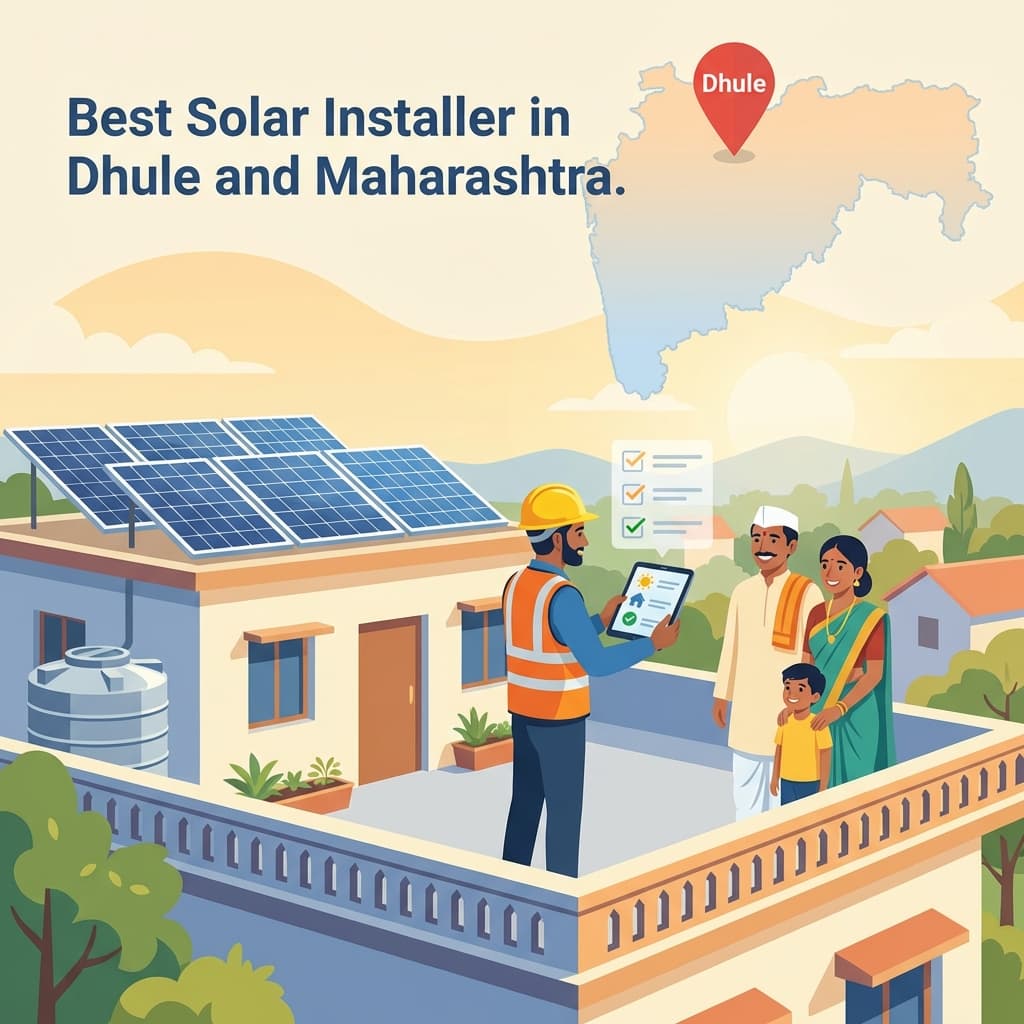
Best Solar Installer in Dhule and Maharashtra: How to Choose the Right EPC Partner (2025 Guide)

Introduction
Choosing a solar installer in Dhule or anywhere in Maharashtra is not like buying a new phone you’ll replace in 2–3 years. A rooftop solar system is a 20–25 year asset. If the design is wrong or the installer disappears after taking payment, you’re stuck with the consequences for decades.
Maharashtra sits in India’s high-solar belt, getting roughly 5–6.5 kWh/m² of solar energy per day and 250–300 sunny days in a year, which makes rooftop solar extremely effective here. Dhule district itself already hosts large solar parks and utility-scale projects, which shows how strong the solar resource is in this region.
The question is not “Does solar work here?”
The real question is: “Which EPC company can I trust to design, install and maintain it properly?”
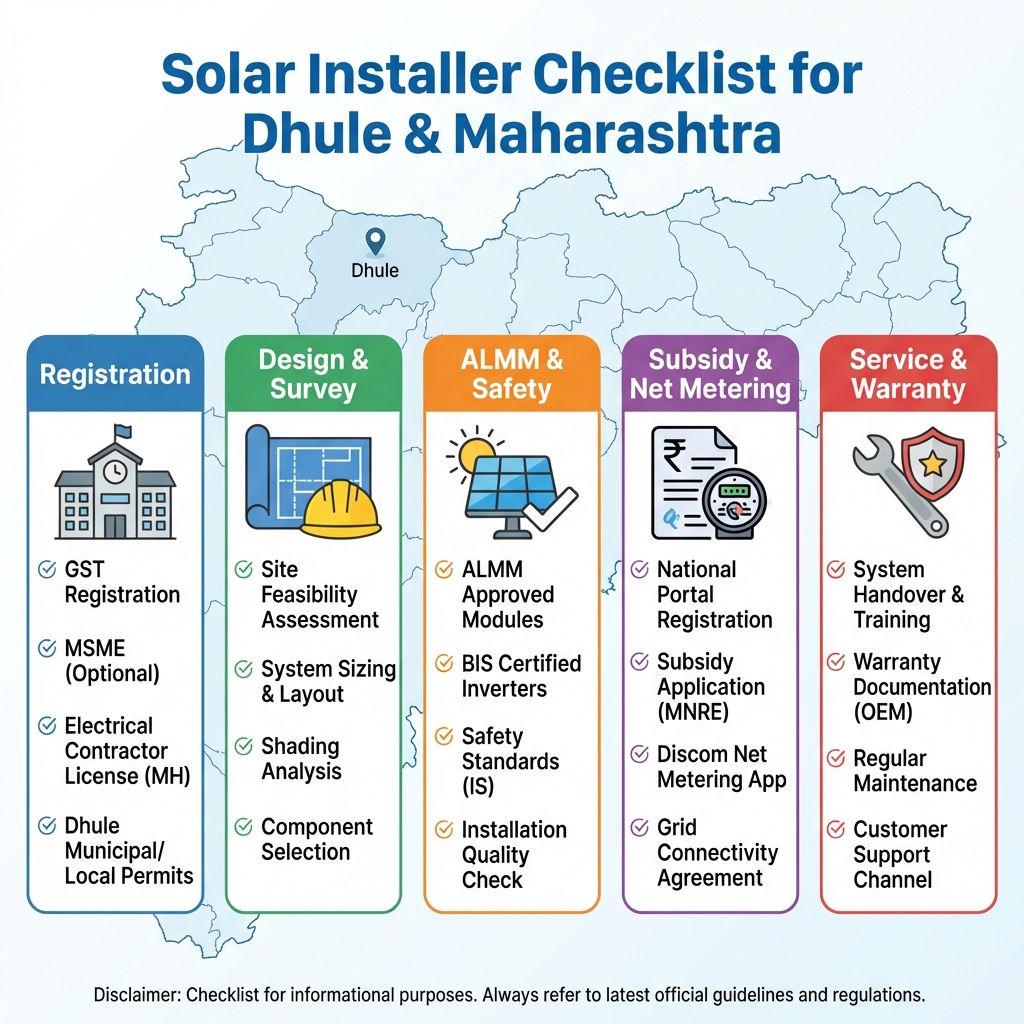
This guide gives you a clear, Dhule– and Maharashtra–focused checklist to compare installers before you sign anything.
What a Solar EPC Partner Actually Does
EPC stands for Engineering, Procurement and Construction:
- Engineering – site survey, system design, structural and electrical design, energy yield estimates.
- Procurement – sourcing panels, inverters, structures, cables and protection devices from reliable manufacturers.
- Construction – installation, mounting, wiring, testing, net-metering formalities and handover.
Good EPC companies also:
- Handle subsidy documentation under schemes like PM Surya Ghar Muft Bijli Yojana for residential projects.
- Ensure ALMM-compliant modules and updated standards are followed.
- Support net metering, which Maharashtra’s regulator recently reaffirmed for rooftop solar projects, keeping payback periods attractive.
If an installer can’t clearly explain these responsibilities, that’s already a warning sign.
Step 1 – Basic Legitimacy: Filters Before You Talk Price
Start with simple, non-negotiable checks. If any answer here is “no”, you move on.
1.1 Business registration and invoicing
Ask:
- Is the installer a registered business (GST-registered, with a verifiable address and PAN)?
- Will you get tax invoices in the company name?
Without proper invoicing, you will struggle with:
- Warranty claims
- Loan processing / EMI
- Future resale or accounting
1.2 Approvals and empanelment
For residential systems, the installer should be familiar with:
- PM Surya Ghar subsidy process (central scheme with up to ₹78,000 subsidy per home, depending on system size).
- Maharashtra DISCOM processes via MSEDCL’s rooftop solar/ISMART portals.
If they claim subsidies but can’t show process flows, documentation samples or portal screenshots, treat that as a red flag.
1.3 Local presence in Dhule / nearby Maharashtra
You want:
- A local or nearby office in Dhule or surrounding North Maharashtra
- A reachable local service team
- Clear response-time commitments (e.g., “we visit within 48–72 hours for genuine faults”)
Installers far away can still build systems, but they rarely respond fast when something breaks in peak summer.
Step 2 – Technical Design Quality (Where Corners Are Usually Cut)
The difference between a safe, high-performing system and a headache usually shows up here.
2.1 Detailed site survey, not just photos
A serious EPC team will:
- Visit your site physically
- Check shadow patterns (nearby buildings, trees, mobile towers)
- Inspect roof condition (RCC, sheet, tile, existing waterproofing)
- Plan cable routing and earthing locations carefully
Shaky surveys = shaky designs. Many post-installation generation complaints are simply “we didn’t realise that tree shadow hits the array at 3 pm”.
2.2 Proper system sizing
A good installer will design based on:
- Your average monthly consumption (units in kWh)
- Tariff slab (MSEDCL bill structure)
- Sanctioned load and phase (single / three-phase)
- Future plans: EV, more ACs, new floors, shop expansion, etc.
If someone pushes “5 kW for everyone” type packages without looking at your bills, they’re optimising for their sales, not your payback.
2.3 ALMM-compliant, quality components
India now enforces an Approved List of Models and Manufacturers (ALMM) for solar modules, with List-I for modules already in place and List-II for solar cells coming into force from 2026.
Ask clearly:
- Are the modules on the latest ALMM List-I from MNRE?
- What is the panel performance warranty (typically 25 years)?
- Which inverter brands are they offering, and what is the standard warranty (5–10 years)?
Cheap, non-listed modules might save a small amount today and cost you big generation losses later.
2.4 Electrical safety and protection
Serious EPCs treat solar as an electrical system first, not a “panel product”. Good practice includes:
- DC and AC surge protection devices (SPDs)
- DC isolators near the array
- Adequate cable sizing and UV-resistant DC cables
- Proper MC4 connectors, not taped joints
- Separate earthing for DC and AC, lightning arrestor for larger systems
- MCB/MCCB protection and labelling inside your distribution board
If the quote is vague like “standard wiring and protection”, push for specifics or walk away.
Step 3 – Transparent Proposal and Honest Pricing
Once an installer passes the first technical filters, move to the commercial side.
3.1 What a good proposal includes
A trustworthy Dhule/Maharashtra EPC quote should clearly show:
-
System size (kW)
-
Expected annual generation in kWh, based on local solar irradiation (Maharashtra gets high annual radiation compared to many other states).
-
Assumptions used:
- Average daily sun-hours
- Your current annual consumption
- Unit rate used (₹/kWh)
-
Full Bill of Materials (BOM):
- Panel brand, model, wattage
- Inverter brand, rating, phase
- Structure type (RCC mount / sheet clamp / elevated structure)
- DC/AC cables, SPDs, earthing kit
-
Cost breakup:
- Material cost
- Labour and installation
- Any civil work (elevated structures, waterproofing, etc.)
- GST
-
Details of:
- Net-metering charges (if any)
- Application / processing fees
- Subsidy handling charges (if applicable)
3.2 Red flags in quotes
Avoid installers who:
- Give only a one-line price: “5 kW solar – ₹X all-inclusive” with no breakup
- Refuse to specify brands until “after payment”
- Are vague about what is included (no mention of structure, earthing, SPDs etc.)
The cheapest quote is often cheap because critical safety and reliability items are missing.
Step 4 – Subsidy, Net Metering and Regulatory Compliance
4.1 PM Surya Ghar Muft Bijli Yojana
For residential customers, the PM Surya Ghar Muft Bijli Yojana provides central subsidies for rooftop solar:
- ~₹30,000 per kW up to 2 kW
- ~₹18,000 per kW for the next 1 kW
- Maximum subsidy typically capped at ₹78,000 for systems larger than 3 kW
Exact numbers and conditions can change, so installers must use current guidelines from the official portals and MSEDCL notices.
A good EPC company will:
- Help you register on the official portal
- Upload necessary documents (Aadhaar, bill, property proof, etc.)
- Coordinate DISCOM inspection and commissioning
- Explain the actual subsidy amount you can expect and timelines for release
4.2 Net metering in Maharashtra
Maharashtra’s electricity regulator (MERC) has recently upheld net metering for rooftop solar in a key decision, confirming that eligible consumers can still offset their consumption by exporting surplus energy to the grid.
Ask your installer:
- Are they up to date with MERC’s latest orders?
- Will your system be commissioned under net metering or gross metering?
- How will that affect your payback period?
If an installer cannot explain the difference between net and gross metering, you should not trust them with a 25-year asset.
Step 5 – After-Sales Service and Monitoring
The work is not over after installation.
5.1 Warranties beyond panels
You should get:
- Panel performance warranty (typ. 25 years) + product warranty (10–12 years)
- Inverter warranty (5–10 years, depending on brand)
- Workmanship warranty from the EPC (for structure, wiring, terminations)
Clarify:
- Who handles warranty claims – you or the EPC?
- Is there a dedicated service contact?
- What are the service charges after the workmanship warranty period?
5.2 Monitoring and performance checks
Most modern inverters offer app-based monitoring. A good EPC will:
- Commission and configure the monitoring app for you
- Explain what to look at (daily generation, grid issues)
- Offer periodic health checks or AMC for:
- Cleaning schedule (dust-heavy in Dhule and much of Maharashtra)
- Tightness checks on structures
- Earthing and insulation testing
Step 6 – Dhule and Maharashtra Specific Factors You Should Consider
Dhule and broader Maharashtra share some practical realities:
- High dust and heat in many regions – panels need regular cleaning to maintain generation.
- Mix of urban roofs and rural/agri structures – from RCC terraces to GI sheds and farm sheds.
- Strong solar resource and rising local tariffs – good for payback if the system is well-designed.
A local EPC that understands wind loads, monsoon patterns, local DISCOM behaviour and municipal norms will usually do a better job than a distant “one size fits all” vendor.
How Ultron Power Systems Fits This Checklist
If you’re evaluating Ultron Power Systems against this checklist, here is how we position ourselves:
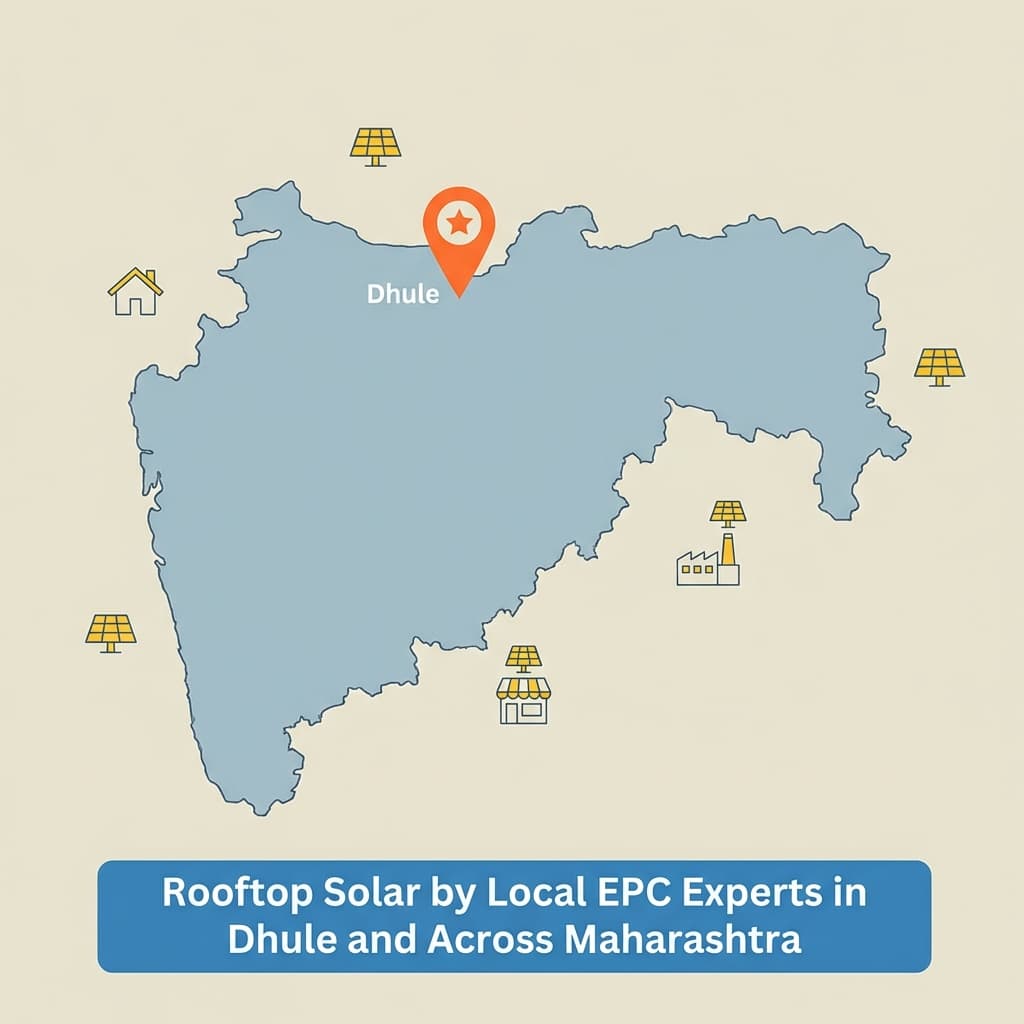
- Local focus: Based in Dhule and serving North Maharashtra and the rest of Maharashtra with on-ground teams.
- Design-first approach: We size systems using your actual MSEDCL bills, tariff slabs and future requirements, not just fixed kW packages.
- Standards and compliance:
- Only work with MNRE/ALMM-listed module brands and reputed inverters, following the latest MNRE and ALMM updates.
- Follow best practices for SPDs, isolators, cable sizing and earthing.
- Subsidy and net-metering support:
- Assist households with PM Surya Ghar applications and DISCOM documentation.
- Design systems aligned with net-metering regulations and MERC orders to keep your payback healthy.
- Service:
- Local, structured service process for fault calls and inspections.
- Guidance on cleaning schedule and AMC options.
You should still use the full checklist on us, just as you would with any other EPC. A good partner prefers informed customers.
Quick Comparison Checklist (Print or Save This)
You can use this section as a mini “scorecard” for any installer:
| Area | Question | Good Sign | Red Flag |
|---|---|---|---|
| Registration | GST-registered, proper company invoices? | Yes, clear GST and company details | Cash / personal account only |
| Local presence | Office/team in or near Dhule / North Maharashtra? | Local office, clear address and contacts | Only central call centre |
| ALMM-compliant modules | Are panels on latest MNRE ALMM List? | Can share ALMM details and data sheets | “Don’t worry, all same” |
| Site survey | Physical survey with shading + structure checks? | They spend time on roof and measurements | Quote only from photos / WhatsApp |
| Design and sizing | Based on your bills and usage? | Asks for 6–12 months of bills, future plans | Pushes fixed kW options blindly |
| Protection & safety | SPDs, isolators, proper earthing, labelled MCBs? | All listed in BOM with brands | “Standard wiring included” only |
| Proposal transparency | Detailed BOM, generation estimates, assumptions, clear breakup? | Full written quote with component list | Single-line “package price” |
| Subsidy & net metering | Can explain PM Surya Ghar and MERC net-metering rules? | Shows process, portals, timelines | Vague promises about “free electricity” |
| Warranties & service | Written workmanship warranty, response SLA, monitoring setup? | Clear document and contact person | “Call us if problem, we’ll see what we can do” |
FAQ: Common Questions from Dhule and Maharashtra Customers
1. Which panel brand is best for Dhule and Maharashtra?
Instead of chasing brand names, focus on:
- Whether the panel is on MNRE’s ALMM List-I
- Performance and product warranty
- Track record of the manufacturer in India
A competent EPC will shortlist a few brands that work well for our climate and budget.
2. How long does it take from booking to commissioning?
For a typical 3–10 kW residential system:
- Site survey and design: a few days
- Application and approvals: depends on MSEDCL workflow at that time
- Installation: usually 2–4 days of work
- Net-metering and final commissioning: varies by location and load on DISCOM, often a few weeks
Ask the installer for realistic timelines based on recent projects in your area.
3. What happens if my inverter shows an error?
In many cases, inverter errors are linked to:
- Grid issues (voltage or frequency out of range)
- Loose connections or earthing problems
- Component failures (rare but possible)
Your installer should:
- Provide a service number or WhatsApp channel
- Have a standard troubleshooting script (restart steps, photos, error code sharing)
- Offer on-site visits within a defined time frame for genuine faults
4. Can I oversize my solar plant to earn money by selling more power?
Maharashtra’s net-metering framework is designed primarily for self-consumption, not for running a power plant on a residential connection.
The sensible approach is to size your system:
- Close to your annual consumption,
- Within the DISCOM’s sanctioned load and technical rules.
A good EPC will show you a financial model that balances export and self-use instead of blindly pushing maximum capacity.
Conclusion: Take Your Time, Ask Hard Questions
Dhule and Maharashtra are perfect places for rooftop solar – strong sun, rising tariffs and growing policy support. The only way this goes wrong is if you rush the installer choice.
Use this checklist to interrogate every EPC company you speak to:
- Legal and local presence
- Engineering depth
- Component quality and ALMM compliance
- Subsidy and net-metering expertise
- Service commitment
If you want a starting point, talk to Ultron Power Systems with this checklist in your hand. Whether you choose us or someone else, you’ll make a decision based on facts instead of marketing lines.
Need a solar partner?
Let’s turn this insight into your next project.
Our engineers can design a custom solar system for your site, handle paperwork, and monitor performance once it is live.
Ultron Solar Team
Editorial Desk
"Our editorial team consists of seasoned solar engineers and policy consultants dedicated to bringing transparent, data-driven energy insights to the people of North Maharashtra."
Share this post